A scientific concept study by SPACEKURD

1. Introduction
Earth’s gravity is the force that keeps everything—from our atmosphere to our daily lives—bound to the planet. For a rocket such as the Vorytec Amed 1, this gravitational force is both a challenge and a starting point.
To reach space and ultimately leave Earth’s gravitational influence, a spacecraft must gain sufficient velocity and follow a precisely calculated trajectory. This article explains the basic physics of Earth’s gravity, orbital motion, and the principles behind the Vorytec Amed 1 concept.
2. Earth’s Gravitational Force
Gravity is a fundamental force of nature. At Earth’s surface, it produces an acceleration of approximately:
g = 9.81 m/s²
The gravitational force between two masses can be described by Newton’s law of universal gravitation:
F = G · (m₁m₂ / r²)
Where:
- F = gravitational force in newtons (N)
- G = gravitational constant, approximately 6.674 × 10⁻¹¹ m³/(kg·s²)
- m₁, m₂ = masses of the two objects
- r = distance between their centers of mass
The gravitational force decreases as the distance from Earth’s center increases. Nevertheless, Earth’s gravity remains significant even hundreds or thousands of kilometers above the surface.
3. Orbital Motion – The Key to Spaceflight
Reaching space does not simply mean travelling upward. A spacecraft must also acquire a very high horizontal velocity.
A spacecraft in Low Earth Orbit (LEO) is continuously falling toward Earth under the influence of gravity. However, because it is moving sideways at very high speed, the curvature of its trajectory follows the curvature of Earth. The spacecraft therefore remains in orbit instead of falling directly back to the surface.
The approximate circular orbital velocity is given by:
v = √(GM / r)
Where:
- v = orbital velocity
- G = gravitational constant
- M = mass of Earth
- r = distance from Earth’s center
At an altitude of approximately 200 km, the orbital velocity is around:
7.8 km/s ≈ 28,000 km/h
This enormous velocity illustrates why orbital flight is primarily a problem of energy and velocity rather than altitude alone.
4. The Vorytec Amed 1 – From Orbit to Freedom
The Vorytec Amed 1 is conceived as a spacecraft capable of delivering satellites and scientific payloads into low Earth orbit. A further mission concept involves increasing the spacecraft’s velocity sufficiently to escape Earth’s gravitationally bound trajectory.
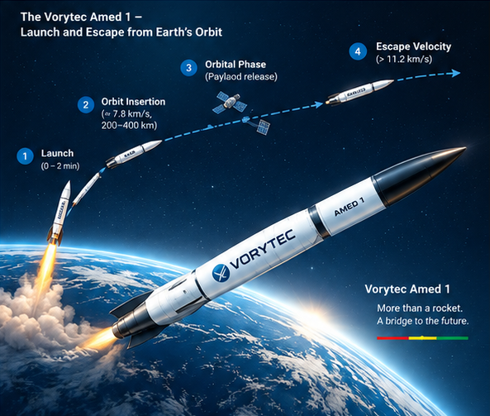
The process can be divided into several phases:
1. Launch
The rocket accelerates from the ground through the atmosphere. Its propulsion system generates thrust to overcome gravitational forces and atmospheric drag while building up both altitude and velocity.
2. Orbit Insertion
After the major atmospheric portion of the ascent, the spacecraft continues accelerating until it reaches the velocity required for its target orbit. At approximately 200–400 km altitude, a typical LEO mission requires an orbital velocity of roughly 7.7–7.8 km/s.
3. Orbital Phase
Once the spacecraft has reached a stable orbit, the payload can be deployed. Depending on the mission architecture, additional propulsion manoeuvres can then increase the spacecraft’s orbital energy.
4. Escape from Earth’s Orbit
To escape Earth’s gravitationally bound trajectory from a low-Earth-orbit region, the spacecraft must reach approximately 11.2 km/s relative to Earth, neglecting atmospheric drag and other practical losses.
This value is known as the escape velocity at Earth’s surface. At higher altitude, the local escape velocity is lower because the spacecraft is farther from Earth’s center.
Importantly, a rocket does not need to instantly reach 11.2 km/s at the surface. Its engines progressively add energy to the spacecraft, and the actual required performance depends on the trajectory, altitude, propulsion system, atmospheric losses, gravity losses, and mission objective.
5. Why It Works
The essential principle is the continuous addition of energy and momentum through propulsion.
During powered flight, the rocket engines accelerate the spacecraft. Once sufficient velocity and orbital energy have been achieved, the spacecraft can follow a trajectory that no longer returns it to Earth.
As the spacecraft moves farther away, Earth’s gravitational influence becomes weaker. However, gravity never suddenly disappears. Instead, its influence decreases continuously with increasing distance.
For an idealized two-body Earth-spacecraft system, the specific orbital energy is:
ε = v²/2 − GM/r
If the total specific orbital energy becomes positive, the resulting trajectory is an escape trajectory rather than a closed elliptical orbit.
6. Conclusion
Earth’s gravity is one of the fundamental physical challenges of spaceflight. It keeps spacecraft bound to Earth unless sufficient energy is supplied to change their trajectory.
The Vorytec Amed 1 concept demonstrates how a launch vehicle can progress from atmospheric ascent to orbital flight and, with additional propulsion and an appropriate mission profile, toward an escape trajectory.
The transition from Earth to space is therefore not simply a question of going higher. It is fundamentally a question of velocity, energy, trajectory and precision engineering.
For SPACEKURD, the Vorytec Amed 1 represents a conceptual step toward a future in which satellites, scientific instruments and other payloads can be transported beyond Earth’s atmosphere.
From the ground, to orbit, to the stars —
with science, technology and vision.
Note: The Vorytec Amed 1 presented in this article is a conceptual spacecraft/launch-vehicle study. The numerical values are based on idealized physical principles and are not a statement of an operational flight capability.
About the Author